
Introduction
Walk through almost any factory floor and you'll find knowledge that exists nowhere in writing. It's in the way a veteran operator adjusts feed rate by feel before a tool breaks. It's in the specific sound a press makes before it starts misfeeding. It's in the mental checklist a shift lead runs through at 2 a.m. that no supervisor ever wrote down.
That's tribal knowledge — the unwritten, undocumented expertise that experienced operators, technicians, and engineers accumulate over years on the floor. And right now, it's leaving faster than the industry can track or replace it.
According to BLS data, 25% of U.S. manufacturing workers — roughly 3.8 million people — are age 55 or older. The Manufacturing Institute projects up to 1.9 million manufacturing roles could go unfilled by 2033.
When experienced workers retire faster than the industry can replace them, decades of undocumented expertise disappears permanently.
This guide covers the real cost of losing that knowledge, why it's so hard to capture, warning signs your facility is already affected, and a practical framework for preserving it before it walks out the door.
Key Takeaways
- 25% of U.S. manufacturing workers are 55+, representing millions of people approaching retirement with undocumented expertise
- Most manufacturing tribal knowledge is sensory, unconscious, and context-dependent — traditional documentation methods can't capture it
- Replacing a skilled worker can cost up to 200% of their annual salary, and productivity gaps persist for months
- Effective knowledge capture must happen during work, not as a separate documentation exercise
- AI-powered capture tools convert real-time floor activity into structured, searchable knowledge — and get more useful the more work they see
Why Tribal Knowledge Loss Is a Manufacturing Crisis
About 10,000 Baby Boomers reach age 65 every day. All 73 million members of that generation will be 65 or older by 2030. In manufacturing specifically, that demographic pressure is colliding with a talent pipeline that can't keep up.
The Downtime Cost Nobody Talks About
When experienced operators leave, the most immediate impact shows up in downtime — and downtime is expensive. Siemens' 2024 True Cost of Downtime report puts the cost of unplanned downtime at $2.3 million per hour in automotive manufacturing, and up to $150,000 per hour for smaller industrial operations. The same report found that average recovery time from downtime incidents grew from 49 minutes to 81 minutes between 2019 and 2024.
Longer recovery times follow directly from thinner experience on the floor — fewer people who've seen the failure before and know exactly what to check first.
The Replacement Cost Problem
Hiring a replacement for a retiring veteran starts a new problem, not a solution. According to SHRM, replacing a key employee can cost up to 200% of their annual salary when you factor in recruiting, onboarding, and the extended productivity ramp.
For skilled trades, that ramp is significant. BLS data shows industrial machinery maintenance workers typically need at least one year of on-the-job training, while millwrights generally complete a 3-4 year apprenticeship. Neither timeline accounts for the informal expertise that takes a decade to develop.
The Compounding Effect Across Shifts
The damage doesn't stay contained to one vacancy. When a veteran operator's undocumented process optimizations disappear:
- Defect rates rise as quality checkpoints that "everyone just knew" go unapplied
- Downtime events take longer to diagnose without pattern recognition built over years
- Junior operators develop workarounds that diverge from each other, eroding consistency
- Training new hires becomes slower and more inconsistent because the most effective teachers are gone
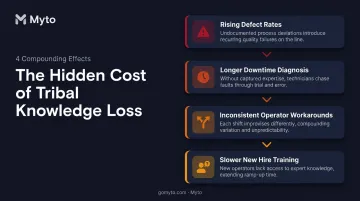
None of these show up on a single P&L line — which is precisely why manufacturers underestimate the damage until multiple vacancies compound at once.
What Makes Manufacturing Tribal Knowledge So Hard to Capture
Most knowledge-preservation initiatives fail at the same point: someone sits down with an experienced operator, asks what they know, and assumes the answer covers it. It doesn't. There are four specific reasons why — and each one explains why traditional methods keep falling short.
It Lives in Perception, Not Words
An experienced machinist doesn't decide to listen for spindle chatter. They just hear it and adjust. A veteran press operator doesn't consciously analyze vibration patterns; they feel something is off and stop the run before anything breaks. These perceptual skills are real and valuable, but they're pre-verbal. They developed through thousands of repetitions over years, and asking someone to articulate them produces a sanitized description that omits most of what actually matters.
It's Largely Unconscious
Veteran workers genuinely don't know everything they know. When you ask them to walk you through a process, they'll describe what the official procedure says — not the fourteen micro-adjustments they make automatically. That gap between "what I said I do" and "what I actually do" is where the most critical knowledge lives.
It's Context-Dependent
Manufacturing expertise isn't a set of universal rules. The right adjustment at 40% humidity is wrong at 70%. The approach that works on a worn machine isn't the same as on a freshly calibrated one. This situational specificity makes template-based documentation inadequate by design. An SOP written for nominal conditions won't help a technician dealing with real-world variability — and that variability is what experienced operators navigate every shift.
Traditional Methods Capture the Wrong Thing
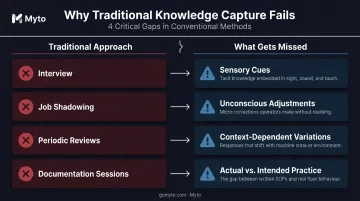
Interviews, job shadowing sessions, and periodic documentation reviews share the same flaw: they ask workers to stop working and explain. This approach:
- Pulls experienced operators away from production
- Produces descriptions of intended practice, not actual practice
- Captures what workers can articulate, not what they do automatically
- Creates documents that feel complete but miss the nuance that matters
Warning Signs Your Factory Is Losing Tribal Knowledge Right Now
These signals are observable without any formal audit. If several apply to your facility, knowledge loss is already underway.
Workforce-Level Warning Signs
Only one or two operators can reliably set up or troubleshoot a specific machine — and no one else understands why their approach works. That's expertise locked in an individual. If that person retires or calls in sick, the machine underperforms or sits idle.
When experienced colleagues struggle to explain what they're actually teaching during onboarding, knowledge transfer is informal and inconsistent. New operators learn who to ask — not what to do.
Operational Warning Signs
If incident duration increases when a particular technician isn't on shift, the operation is depending on personal expertise rather than institutional knowledge. The workaround "everyone just knows" exists nowhere recoverable.
When root cause analysis finds that the solution existed in one person's head — no log entry, no SOP reference, no training record — your documentation doesn't reflect how the floor actually operates.
Documentation Warning Signs
- Official SOPs exist but floor workers routinely bypass them for informal practices that "actually work"
- Newly onboarded employees report that formal documentation doesn't match what senior colleagues actually show them
- Workers learn to rely on asking specific people rather than consulting any official resource
- Experienced operators improved processes over the years but never documented the changes
A Practical Framework for Capturing and Preserving Tribal Knowledge
Effective knowledge preservation isn't a one-time documentation project. The manufacturers who get this right treat it as an ongoing operational practice — with defined priorities, the right tools, and cultural reinforcement built into daily work.
Start with High-Risk, High-Impact Knowledge Areas
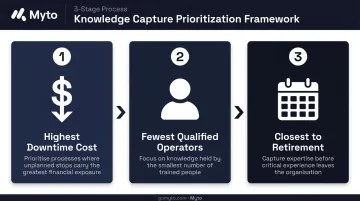
Before trying to capture everything, identify what to protect first. A useful starting framework:
- Highest downtime cost — Which machines, when they stop, cause the most expensive delays?
- Fewest qualified operators — Where does knowledge sit in only one or two people?
- Closest to retirement — Which veterans are most likely to leave within the next 12-24 months?
Prioritizing these three criteria creates immediate ROI and builds internal momentum for broader rollout. Capturing everything at once produces an overwhelming project that stalls.
Engage Experienced Workers as Active Partners
Experienced workers sometimes resist knowledge capture for understandable reasons — concern about job security, discomfort with being observed, or the feeling that their expertise is being extracted rather than valued. These concerns are addressable.
Effective approaches include:
- Framing knowledge capture explicitly as honoring their expertise and legacy
- Involving them in deciding what gets documented and how
- Making clear that the goal is to give newer workers the benefit of their experience — not to eliminate their role
- Recognizing their contributions publicly and formally
Workers who feel like partners in the process produce far richer knowledge assets than those who feel like passive subjects being studied.
Embed Capture Into the Flow of Work
This is where most traditional approaches fail completely. Asking operators to stop, open a documentation system, and record what they just did creates friction — and friction means it rarely gets done. The most critical knowledge (the mid-shift adjustment, the instinctive diagnosis, the workaround developed over years) happens fast and disappears just as quickly.
The most effective knowledge capture happens during the work: mid-repair, during setup, at the moment of a quality decision.
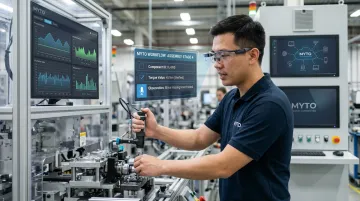
That's what Myto is designed for. The platform pairs wearable AI glasses with agentic AI — operators keep working normally, no recording to start, no narration required, while the system captures what's happening hands-free.
Because the glasses capture both audio and video, they record the sensory cues that matter most: the sound of a bearing starting to fail, the subtle vibration pattern before a spindle problem develops. Agentic AI then transforms that footage into structured SOPs, troubleshooting flows, training content, and shift-handover documentation automatically.
That captured knowledge feeds into an Operational Data Integration layer alongside data from existing CMMS, MES, SCADA, and ERP systems — connecting frontline expertise with machine history, maintenance tickets, and prior repair records. Over time, each captured interaction makes the next diagnosis faster and the next handover cleaner.
Validate, Standardize, and Continuously Update
Captured knowledge is only valuable if it's accurate, accessible, and kept current. Documentation that reflected best practice in 2020 may be wrong in 2025 after equipment upgrades or process changes.
Key practices for keeping knowledge assets current:
- Verify documented practices against actual floor activity — periodic spot checks catch drift between documentation and reality
- Build feedback loops that allow operators to flag when a documented procedure doesn't match current conditions
- Assign ownership for knowledge assets to specific roles, not just "the quality team"
- Treat updates as routine maintenance, not exceptional events
The goal is documentation that workers trust enough to use when it matters — and workers don't trust documentation they've seen contradict real conditions.
Conclusion
The retirement wave is already underway. Every week, experienced operators and technicians leave manufacturing facilities carrying decades of accumulated expertise that no job posting can replace. Waiting for a better time to address this only guarantees the problem gets worse.
Manufacturers who act now have a real opportunity. When frontline expertise gets captured systematically and transformed into a structured organizational asset, the facility doesn't just reduce downtime and training costs — it builds a factory that gets smarter over time.
Each repair documented, each workaround recorded, each veteran's instinct preserved in retrievable form compounds into a foundation that pays off for new hires, future shifts, and production challenges that haven't happened yet. Platforms like Myto are built specifically for this — capturing knowledge in the natural flow of work before it has a chance to leave.
The knowledge is still there. The question is whether you capture it before it walks out the door.
Frequently Asked Questions
What is tribal knowledge in manufacturing?
Tribal knowledge in manufacturing refers to the undocumented expertise experienced workers develop over years on the floor — including setup techniques, troubleshooting instincts, and process adjustments that exist only in individuals' heads, not in any manual or training material. It's the gap between what the SOP says and what experienced operators actually do.
How do you capture tribal knowledge in manufacturing?
The most effective approaches prioritize high-risk knowledge first, engage experienced workers as active partners, and embed capture into the natural flow of work. After-the-fact interviews and documentation sessions consistently fall short — they record what workers can articulate, not what they actually do.
Why is tribal knowledge so difficult to document?
Manufacturing expertise is sensory, contextual, and often unconscious — veterans rely on sounds, tactile feedback, and pattern recognition they can't fully verbalize, and that written formats can't capture. When asked to explain their process, most experienced operators describe the official procedure, not the adjustments that actually drive performance.
What happens when experienced workers retire without transferring their knowledge?
The consequences include longer downtime events as less experienced workers struggle to diagnose problems, extended recovery times, higher defect rates as informal quality checkpoints disappear, and significant retraining costs. These effects worsen as more experienced workers leave and the average tenure on the floor continues to drop.
What is tribal knowledge in software?
In software and IT contexts, tribal knowledge refers to undocumented system configurations, deployment steps, architectural decisions, and operational workarounds that only certain engineers or IT staff understand. When those individuals leave, the organization loses institutional knowledge that can be extremely difficult and expensive to reconstruct.
What role does AI play in preserving tribal knowledge in manufacturing?
AI-powered platforms like Myto capture expertise passively during the flow of work — including sensory cues like machine sounds — and convert unstructured operator activity into structured SOPs and troubleshooting guides without extra steps. Integrated with existing plant systems, this makes knowledge preservation continuous rather than a periodic project tied to operator availability.