Introduction
Manufacturing is under real pressure. Facilities are expected to produce more, faster, and with fewer errors — yet many still run on manual processes, disconnected systems, and undocumented know-how that creates expensive bottlenecks. A line goes down at 2 AM, and the one technician who knows how to fix it isn't answering the phone.
That gap — between what modern manufacturing demands and what most facilities can actually deliver — is driving the fastest adoption of automation technology the industry has seen.
This guide covers manufacturing process automation end-to-end: what it is, the core types, key benefits, a step-by-step implementation framework, and what AI is changing about the knowledge layer most automation programs never touch.
The IFR reported 542,076 industrial robots installed worldwide in 2024 — the fourth consecutive record year above 500,000 units — with forecasts exceeding 700,000 annual installations by 2028. Manufacturers not moving on automation now are already falling behind.
Key Takeaways
- Automation spans physical production (robots, PLCs, machinery) and information processes (data capture, reporting, ERP integration)
- Five types of automation — fixed, programmable, flexible, IIoT, and CIM — each fit different production volumes and variability levels
- Automation payback periods have improved from 5–8 years historically to 1–3 years in many current manufacturing contexts
- Poor planning — not technology — drives most implementation failures; a structured 7-step approach reduces that risk significantly
- Capturing what experienced operators know — and turning it into AI-powered intelligence — is the automation challenge most factories haven't solved yet
What Is Manufacturing Process Automation?
Manufacturing process automation is the use of technology — robotics, AI, software, PLCs, and control systems — to perform production tasks with reduced or no human intervention. The goal is straightforward: cut cycle times, improve consistency, and reduce the errors that manual labor introduces.
Automated systems follow programmed logic or learned patterns to control machinery, manage workflows, collect data, and execute tasks continuously and reliably.
Physical Automation vs. Information Automation
Most people think of automation as machines doing physical work. That's accurate but incomplete. There are two distinct layers:
- Physical process automation — equipment, robots, sensors, PLCs, and machine control. The hardware that performs assembly, welding, packaging, and fabrication.
- Information process automation — the data and workflow layer: MES systems tracking production in real time, ERP systems receiving automated floor feeds, shift reports generated automatically, and dashboards that update the moment a machine goes down.
Both layers matter. A facility can deploy the most advanced robotic cells in its industry and still lose hours every week because the information layer — documentation, handoffs, troubleshooting records — runs entirely on manual effort and tribal knowledge.
The ISA-95 standard framework formalizes this separation across five levels, from physical production processes at Level 0 through business planning and ERP at Level 4. Most facilities have made progress on the physical levels — but Levels 3 and 4, where operational data becomes decisions, remain the gap that costs the most to ignore.
The Main Types of Manufacturing Process Automation
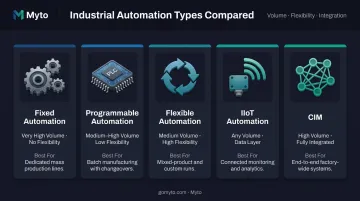
No single automation type fits every facility. The right choice depends on production volume, product variability, and operational goals. There are five core categories worth understanding.
Fixed Automation
Also called "hard" automation, fixed automation uses equipment pre-configured for one specific, high-volume task. Think automotive stamping lines or beverage bottling. Commands are built into the hardware itself : cams, gears, wiring. It delivers maximum throughput speed and consistency at scale, but changing the product typically means replacing the equipment entirely.
Best for: Facilities running massive volumes of a single product with no variation requirements.
Programmable Automation
Controlled by PLCs or CNC systems, programmable automation can be reprogrammed between production batches. The tradeoff is changeover time — equipment must be physically or programmatically reconfigured between runs, creating nonproductive downtime.
Best for: Batch production environments with moderate product variation, such as electronics manufacturing or industrial components.
Flexible Automation
An extension of programmable automation where product changeovers happen via software reprogramming alone — no physical reconfiguration needed. This enables mixed-product production runs without grouping identical items into batches.
Best for: On-demand manufacturing, mass customization, or facilities that need to switch between product variants quickly.
Industrial Internet of Things (IIoT)
IIoT connects machines via sensors that share real-time operational data — machine states, temperatures, cycle counts, fault codes — enabling remote monitoring, predictive maintenance, and data-driven decisions. Deloitte's 2025 Smart Manufacturing Survey found 46% of manufacturers use IIoT solutions at the facility or network level.
IIoT creates the data foundation that makes smarter, self-optimizing factories possible. Without it, most of what happens on the floor stays invisible to decision-makers.
Best for: Facilities looking to reduce unplanned downtime, improve visibility, or build toward predictive maintenance programs.
Computer-Integrated Manufacturing (CIM)
CIM represents the most comprehensive form of automation: full integration of CAD, CAM, quality control, and distribution into one interconnected automated system. Every stage of manufacturing is linked, with data flowing continuously across production, quality, and logistics.
Best for: Large facilities with mature automation foundations that are ready to unify every production stage into a single, data-driven system. IIoT typically builds the foundation that makes CIM achievable.
Quick Comparison: Which Automation Type Fits Your Operation?
| Type | Production Volume | Flexibility | Best For |
|---|---|---|---|
| Fixed | Very high | None | Single product, high repeatability |
| Programmable | Medium–high | Low (batch changeovers) | Batch runs with moderate variation |
| Flexible | Medium | High (software-only changeover) | Mixed-product, on-demand runs |
| IIoT | Any | N/A (data layer) | Visibility, predictive maintenance |
| CIM | High | Integrated | Fully unified, end-to-end automation |
Key Benefits of Manufacturing Process Automation
Efficiency and Output
Automated systems don't get tired, don't take breaks, and don't slow down at the end of a shift. Deloitte's survey of 600 manufacturing executives found smart manufacturing initiatives delivered 10% to 20% improvement in production output and 10% to 15% unlocked capacity. One CPG manufacturer that automated food-processing and packaging lines saw productivity increase by over 70% in processing and nearly 280% in filling and packaging, consolidating operations from four plants into one.
Product Quality
Manual processes introduce variability — slightly different torque, slightly different positioning, slightly different inspection attention depending on who's working. Automation eliminates most of that variability through pre-programmed tolerances and real-time monitoring. McKinsey reported Industry 4.0 manufacturing cases where one European automotive factory reduced warranty incidents by 50% and leading factories achieved a 40% increase in tasks completed correctly on the first pass.
Cost Reduction
Robot costs have fallen more than 50% over 30 years, and the expected payback period on automation investments has improved from a historical 5–8 years to 1–3 years in many current manufacturing contexts. Savings come from multiple directions:
- Lower labor costs for repetitive tasks
- Reduced material waste through precision
- Fewer defects, less rework, fewer recalls
- Continuous 24/7 operation without overtime costs
Worker Safety
Automation takes on the tasks most likely to cause injury — heavy lifting, exposure to toxic substances, high-heat environments, and high-repetition motions. NBER research found that increased robot exposure reduced annual manufacturing work-related injury rates by approximately 1.75 cases per 100 full-time workers, with estimated injury-cost savings of $1.69 billion annually (in 2007 dollars).
Workers in automated facilities shift into monitoring, maintenance, and problem-solving roles — applying judgment where repetitive physical tasks no longer demand their attention.
Real-Time Data and Decisions
When machines are instrumented and connected, every cycle generates a continuous stream of data — cycle times, fault codes, output counts, temperature readings. That stream feeds real-time dashboards and enables operational decisions based on actual production data rather than end-of-shift estimates.
Root-cause analysis that once took hours now takes minutes. Teams move from detecting a problem to diagnosing its source before the next shift begins.
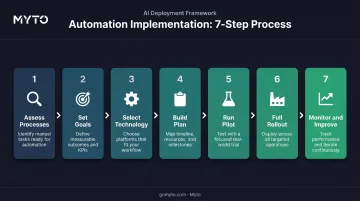
How to Implement Manufacturing Process Automation: 7 Steps
Automation implementation fails most often not because the technology doesn't work, but because the planning didn't happen. A structured approach reduces risk and dramatically improves outcomes.
Step 1 – Assess Your Current Processes
Before selecting any technology, map current workflows in detail. Identify inefficiencies, bottlenecks, and repetitive tasks that are genuinely automatable. Skipping this step leads to automating broken processes rather than fixing them — which just makes the broken process faster.
Step 2 – Set Clear, Measurable Automation Goals
Define SMART goals tied to real business outcomes: reduce production lead time by 20%, cut defect rate by 15%, eliminate manual data entry from shift reporting. Specific goals make technology selection easier and success evaluation possible.
Step 3 – Select the Right Automation Technology
Consider the type of automation needed, scalability requirements, integration with existing systems, and total cost of ownership. The right fit depends on product type, production volume, and budget. A flexible automation system suited to a job shop would be overkill and expensive for a high-volume single-product line.
Step 4 – Build a Comprehensive Implementation Plan
The plan should cover:
- Phased timeline with defined milestones
- Budget including hardware, software, integration, and training
- Risk mitigation for legacy system integration
- Change management strategy for frontline teams
Integration with legacy equipment and enterprise systems (ERP, MES) is where implementation plans most frequently underestimate complexity. Address it explicitly, early.
Step 5 – Run a Pilot Before Full Deployment
Deploy automation in a limited scope first. Measure key metrics (cycle time, error rates, throughput) before and after. Gather frontline operator feedback and refine the system before committing to facility-wide rollout.
According to McKinsey research, fewer than one-third of manufacturers had moved critical digital manufacturing use cases to large-scale deployment — with many stuck in "pilot purgatory." Treating the pilot as a real test, not a demonstration, is what prevents that.
Step 6 – Execute Full-Scale Rollout
Deploy the refined system across all relevant production areas. A clear rollout plan should include:
- Staff training before go-live
- Defined deployment milestones by production area
- Accessible support resources for operators
Operator buy-in at this stage determines whether the automation gets used as designed or gets worked around.
Step 7 – Monitor, Maintain, and Continuously Improve
Automation is not a one-time installation. Ongoing performance monitoring, scheduled maintenance, and continuous improvement are essential. The best automation systems get smarter over time as they accumulate operational data. That only happens if someone is actively reviewing what the data reveals.
Challenges of Manufacturing Process Automation
High Upfront Investment
Automation systems require significant capital expenditure: hardware, software, integration work, and training. Robot costs have dropped more than 50% over the past three decades, and payback periods now average 1–3 years in many manufacturing contexts. Approaches that help manage financial risk include phased rollouts (start with one line or one process), ROI modeling before committing capital, and leasing options for robotic cells.
Workforce Skills Gaps and Knowledge Transfer
The Manufacturing Institute projects manufacturers will need as many as 3.8 million new employees between 2024 and 2033, with 1.9 million jobs potentially going unfilled. As automation replaces manual tasks, existing workers need to be upskilled for roles that involve operating, monitoring, and improving automated systems.
A compounding problem sits underneath the hiring gap: a significant portion of the current manufacturing workforce is within 10 years of retirement, and most of what they know was never documented. It lives in their heads. When they leave, that knowledge leaves with them.
Platforms like Myto address this directly. Using wearable AI glasses, Myto captures how senior operators actually troubleshoot equipment, handle shift transitions, and run their lines — in the natural flow of work, with no extra steps required. That expertise gets automatically structured into SOPs, troubleshooting flows, and training content before the operator retires. New hires inherit institutional knowledge that would otherwise be gone on day one.
Practical steps for closing the skills gap include:
- Document before the departure — capture senior operator expertise while those workers are still on the floor
- Build upskilling into automation rollouts — train workers on new systems during phased deployments, not after
- Pair experienced operators with incoming hires — structured mentorship accelerates knowledge transfer faster than written manuals alone
System Integration Complexity
Connecting new automation technology to existing legacy equipment and enterprise systems (ERP, MES, CMMS) is technically complex and time-consuming. Best practices:
- Prioritize open standards — OPC UA for machine connectivity, standard API layers for enterprise integration
- Plan integration architecture before purchasing — technology that can't talk to your existing systems creates a new silo, not a solution
- Validate compatibility during the pilot phase — not after full deployment
AI, Knowledge Capture, and the Future of Manufacturing Automation
The next wave of manufacturing automation isn't just about machines doing more physical work. It's about automating the information and knowledge layer — capturing what skilled operators know, how they troubleshoot, and how lines actually run, then making that intelligence available across the entire production team.
The Tribal Knowledge Problem at Scale
Even in highly automated factories, critical expertise lives in people's heads. Experienced technicians who know why a specific machine vibrates before it fails. Operators who can diagnose a fault before it triggers an alarm. Shift leads who know which supplier's material runs differently. Manufacturing Institute research found 97% of firms were aware of the aging-workforce issue and 97% were concerned about "brain drain" — the loss of technical and institutional knowledge as experienced workers retire.
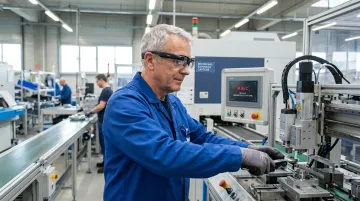
When those workers leave, that knowledge disappears. No ERP system captures it. No CMMS documents it. It's simply gone.
How AI Platforms Are Closing the Gap
Myto combines wearable AI glasses with agentic AI to turn the factory floor's unstructured expertise into structured, searchable, actionable intelligence. Operators wear the glasses during normal work — no clipboards, no extra steps. The glasses record troubleshooting procedures, shift handoffs, and expert behavior as it actually happens.
That captured footage and audio feeds automatically into the Myto platform, where AI structures it into:
- SOPs and troubleshooting flows built from real operator behavior
- Shift-handover documentation assembled without manual input
- Diagnostic checklists surfaced the moment a specific machine fails
- Onboarding content tied to the actual equipment a new operator will run
Every captured interaction makes the knowledge base richer. As the platform accumulates operational data, the gap between what's documented and what experienced operators actually know closes over time rather than growing.
Where Manufacturing Automation Is Heading
IIoT, agentic AI, and predictive analytics are pushing manufacturing beyond physical task automation. The direction is factories that:
- Monitor themselves through connected sensors and real-time analytics
- Diagnose problems using AI trained on plant-specific machine history and operator expertise
- Document automatically rather than relying on manual record-keeping
- Learn from every production run, every downtime event, every resolved fault
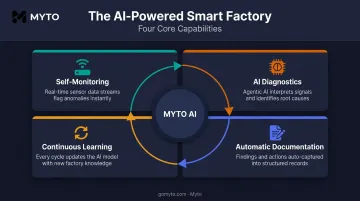
Facilities that automate both layers — machines and the knowledge behind them — are building an advantage that compounds with every shift. Those that address only the physical side will find the gap harder to close as more operations-intelligence platforms mature.
Frequently Asked Questions
What is manufacturing process automation?
Manufacturing process automation uses technology — including robotics, AI, PLCs, and software — to perform production tasks with minimal human intervention. The goal is to increase efficiency, accuracy, and output while reducing manual labor, variability, and errors across both physical production and information processes.
What are the main types of manufacturing process automation?
The five core types are fixed automation, programmable automation, flexible automation, IIoT, and computer-integrated manufacturing (CIM). The right type depends on production volume, product variety, and operational goals: high-volume single products suit fixed automation, while mixed-product environments need flexible or programmable approaches.
What are the biggest challenges of implementing manufacturing automation?
High upfront investment, workforce upskilling, and integration complexity with existing systems are the primary hurdles. Structured planning, phased rollouts, and ROI modeling help manage costs and risk. Addressing knowledge capture before senior operators retire is increasingly critical and often overlooked.
How long does it take to implement manufacturing process automation?
Timelines vary by scope. A pilot program can go live in weeks; full-scale deployment across a facility typically takes months to over a year. Comprehensive robotics integration with legacy systems sits at the longer end of that range.
How does AI improve manufacturing process automation?
AI enables automation systems to learn, predict, and adapt rather than just executing pre-programmed rules. This includes predictive maintenance, real-time optimization, autonomous troubleshooting, and — increasingly — the capture and deployment of human expertise that traditional automation cannot replicate.
What are the 3 D's of automation?
The original framework covers three categories: Dull (repetitive, monotonous tasks), Dirty (environments that are hazardous to health), and Dangerous (high-injury-risk work). These categories help manufacturers identify which processes to automate first. Some frameworks add "Dear" (expensive manual labor) as a fourth consideration.