](https://file-host.link/website/gomyto-u49w2a/assets/blog-images/e8cc99ed-2457-45cf-b6ac-d5b32be153ac/1781169222038002_9a1a97aa112b4dce863e0354e7f7e760/360.webp)
Introduction
U.S. manufacturers added over $2.96 trillion to the U.S. economy in Q4 2025 — yet most shop floors still run on outdated binders, disconnected systems, and expertise that lives exclusively in veteran workers' heads. When those workers retire, that knowledge walks out the door with them.
The stakes are high. According to Siemens' 2024 True Cost of Downtime report, unplanned downtime costs the world's 500 largest companies $1.4 trillion annually — with a single large automotive plant losing up to $2.3 million per hour when lines go down.
AI software is changing this reality. Beyond automating repetitive tasks, today's manufacturing AI platforms capture tribal knowledge, bridge disconnected systems, and give frontline teams the context they need to make faster decisions before production stalls.
This guide covers the best AI software for manufacturing workflow automation: what each platform does, how to evaluate them, and how to pick the right tool for your biggest operational gap.
Key Takeaways
Key takeaways before you read on:
- The best platforms go beyond task routing: they capture operational knowledge, enable predictive decisions, and connect to existing ERP, MES, and CMMS systems
- Five categories covered: frontline knowledge capture (Myto), MES-native intelligence (Siemens Opcenter), enterprise AI (C3.ai), RPA automation (UiPath), and workflow orchestration (Microsoft Power Automate)
- Match the tool to your gap: knowledge retention, predictive maintenance, shop floor execution, or cross-system orchestration
- Most facilities need three things from any tool: minimal IT lift, a UI operators will actually use, and clean ERP/MES integration
- The right platform gets stronger over time: the more operational data it ingests, the more accurate and useful it becomes
What Is AI-Powered Manufacturing Workflow Automation?
AI-powered manufacturing workflow automation uses machine learning, agentic AI, and intelligent process orchestration to replace manual, disconnected, or tribal operational processes on the shop floor. The scope covers work order generation, quality inspection, shift handoffs, predictive maintenance, and real-time production decisions.
How It Differs From Generic Automation
Standard business process automation routes data between SaaS applications based on fixed rules. Manufacturing automation works differently: physical-world context changes what the system needs to interpret, not just route.
Effective manufacturing AI must interpret:
- Machine states and sensor readings
- Operator actions and physical workflows
- Production schedules and shift history
- Maintenance logs and failure patterns
Generic workflow tools aren't built for this environment. Purpose-built manufacturing AI is.
The Market Is Moving Fast
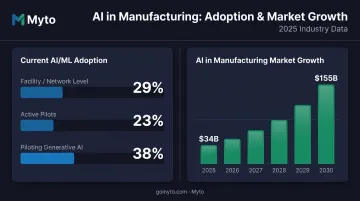
According to Deloitte's 2025 Smart Manufacturing and Operations Survey, 29% of manufacturers already use AI/ML at the facility or network level, with another 23% running active pilots. Generative AI adoption is moving even faster — 38% are currently piloting it. The AI in manufacturing market is projected to grow from $34 billion in 2025 to over $155 billion by 2030.
The platforms below cover five distinct workflow automation categories, evaluated on operational impact, integration depth, and proven fit for factory environments.
Best AI Software for Manufacturing Workflow Automation
Tools were selected based on manufacturing-specific relevance, integration capability with plant systems, frontline usability, and demonstrated operational impact — not general software ratings or brand recognition.
Myto
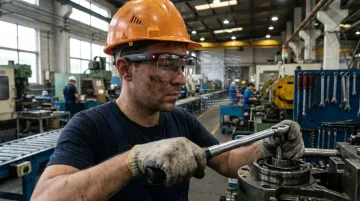
Myto is a manufacturing intelligence platform that combines wearable AI glasses with agentic AI to capture undocumented frontline expertise in the natural flow of work. The system turns tribal knowledge, machine history, and real operator workflows into structured, actionable intelligence, with no added burden on operators.
Where it stands out: Myto's AI agents are trained on each plant's specific operational data: SOPs, machine history, ticket logs, and captured operator expertise. They handle real operational work autonomously — opening maintenance tickets when equipment acts up, drafting shift-handover notes, scheduling follow-ups, and surfacing the right troubleshooting context when a worker needs it.
The wearable glasses capture what never makes it into documentation: how senior techs actually fix recurring problems, how experienced operators detect issues through sound or observation, how shift leads manage downtime events from start to recovery. Captured footage syncs automatically to the platform, where agentic AI structures it into SOPs, troubleshooting flows, and training content. The system compounds as more frontline activity is captured and more factory data is ingested.
Backed by Y Combinator and General Catalyst. Trusted by Mercedes-Benz, Audi, and Amazon, with a team from Mercedes-Benz, BCG, Stanford, Google, and Amazon.
| Attribute | Details |
|---|---|
| Key Features | Hands-free wearable capture, agentic AI for documentation and troubleshooting, automated shift handoffs, frontline knowledge standardization |
| Best For | Factories with tribal knowledge risk, high operator turnover, or unplanned downtime driven by undocumented processes |
| Deployment | Minimal IT lift, no heavy infrastructure required, built for frontline teams from day one |
Siemens Opcenter
Siemens Opcenter is an enterprise Manufacturing Execution System (MES) with AI-driven production management capabilities. It covers scheduling, quality management, performance tracking, and real-time shop floor visibility, and is widely deployed across automotive, electronics, discrete, and pharmaceutical manufacturing.
Key differentiator: Deep integration with Siemens' Digital Industries ecosystem enables AI-powered scheduling optimization and digital twin capabilities. Opcenter provides a centralized workflow orchestration layer for large-scale production environments where multiple lines, facilities, and production schedules need to run in coordination.
Customer examples include Meccanotecnica Umbra S.p.A., which used Opcenter to eliminate paper-based processes and reduce production costs, and Siemens Industrial Turbomachinery, which adopted it as a single source of truth for production data accuracy.
| Attribute | Details |
|---|---|
| Key Features | AI-assisted production scheduling, quality management, real-time OEE monitoring, digital twin integration |
| Best For | Large manufacturers seeking an enterprise-grade MES with AI workflow capabilities built in |
| Integration Depth | Native integration with SAP, Oracle EBS, and Siemens Teamcenter PLM via Active Integration framework |
C3.ai
C3.ai is an enterprise AI application platform with purpose-built solutions for manufacturing, including predictive maintenance, supply chain optimization, production schedule optimization, and process quality AI. It serves major industrial enterprises and energy companies including Holcim and Shell.
The real advantage: Pre-built AI applications tuned for manufacturing use cases mean faster time-to-value than building custom models from scratch. C3 AI Reliability identifies equipment maintenance needs before failures occur. C3 AI Process Optimization helps production engineers improve yield and reduce off-spec product through dynamic process-control recommendations.
For organizations running SAP or Oracle environments, C3.ai's prebuilt connectors and dedicated SAP integration layer reduce integration complexity.
| Attribute | Details |
|---|---|
| Key Features | Predictive maintenance AI, supply chain intelligence, production quality monitoring, pre-built ML models |
| Best For | Enterprises adding AI-driven decision automation on top of existing ERP/MES infrastructure |
| Pricing | Enterprise licensing; contact C3.ai for a custom quote |
UiPath
UiPath is a leading Robotic Process Automation (RPA) platform that has evolved to include AI-powered document understanding, computer vision, and process orchestration. For manufacturers, it automates data-heavy workflows like work order processing, compliance documentation, quality reporting, and legacy system interactions.
Why it matters: Mature RPA governance and orchestration capabilities make UiPath well-suited for manufacturers running legacy ERP systems or paper-heavy processes. Rather than replacing existing infrastructure, UiPath's bots work on top of it, automating high-volume, rules-based tasks that would otherwise require manual entry.
MAS Holdings used UiPath to automate 52 processes and save 14,000 labor-days annually — demonstrating the scale of impact RPA can deliver in a manufacturing environment.
| Attribute | Details |
|---|---|
| Key Features | AI-powered document processing, RPA bots for legacy system automation, computer vision for inspection workflows, centralized bot orchestration |
| Best For | Manufacturers with legacy ERP or paper-based processes needing AI-driven automation without full system replacement |
| Deployment | Cloud, on-premises, and hybrid; enterprise pricing available |
Microsoft Power Automate
Microsoft Power Automate is an enterprise workflow automation platform with native integration across Microsoft 365, Dynamics 365, and Azure IoT. For manufacturers operating in the Microsoft ecosystem, it enables automation of production workflows, approval chains, maintenance alerts, and reporting without custom development.
Where it stands out: AI Builder, embedded within Power Automate, allows teams to deploy AI models for form processing, object detection, and predictive analytics into existing workflows with minimal coding. The Azure IoT Central connector creates rules that trigger Power Automate workflows automatically when IoT telemetry conditions are met, bridging shop floor sensor data with enterprise workflow automation.
Pricing starts at $15.00 per user/month for Power Automate Premium (billed annually), with process automation available at $150.00 per bot/month.
| Attribute | Details |
|---|---|
| Key Features | AI Builder for model deployment, Azure IoT integration, approval workflow automation, desktop RPA for legacy app interaction |
| Best For | Microsoft-centric manufacturers seeking governed, low-code workflow automation with AI across their existing tech stack |
| Pricing | Premium: $15/user/month; Process: $150/bot/month (annual billing) |
How We Chose the Best AI Software for Manufacturing Workflow Automation
The Evaluation Framework
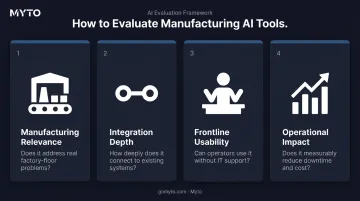
Every tool on this list was assessed against four criteria specific to manufacturing environments:
- Manufacturing relevance — does the platform address actual shop floor problems, or is it a general-purpose tool with manufacturing marketing wrapped around it?
- Integration depth — can it connect to existing MES, ERP, IoT, and CMMS systems without requiring a full infrastructure replacement?
- Frontline usability — will operators, maintenance techs, and shift leads actually use it, or does it create more friction than it removes?
- Operational impact — is there documented evidence of reducing downtime, improving documentation, or accelerating decisions?
A common mistake in tool selection: choosing based on brand recognition or generic software rankings rather than operational fit. A platform that scores well on G2 may be completely wrong for a factory floor where workers can't stop to type and legacy systems are 15 years old. That gap between general-purpose reviews and factory-floor reality is exactly what the criteria above are designed to close.
What the Best Tools Have in Common
Across all five platforms, three characteristics separate genuinely useful manufacturing AI from tools that stall in pilot purgatory:
- Reduce friction for frontline teams — operators adopt them without extra steps or retraining
- Connect to existing plant infrastructure (MES, ERP, CMMS) without demanding a full overhaul
- Get stronger over time as they ingest real operational data from your specific facility
Gartner reported that at least 50% of generative AI projects were abandoned after proof of concept by end of 2023, with poor data quality cited as the primary failure driver. Manufacturing AI tools that ingest real operational data from day one — rather than requiring clean data lakes before delivering value — avoid this trap.
Pricing models and IT requirements mattered too — most manufacturing IT teams operate lean. Months-long implementations before seeing any ROI are a non-starter for plant operations teams.
Conclusion
The tools covered here address the full spectrum of manufacturing workflow automation — from capturing tribal knowledge before it retires with senior operators, to predicting equipment failures before they halt production, to automating the back-office workflows that slow shop floor execution.
Before selecting a platform, assess your most urgent operational gap:
- Knowledge retention and tribal knowledge risk → Myto
- Predictive maintenance and process optimization → C3.ai
- MES-level shop floor orchestration → Siemens Opcenter
- Legacy system and document-heavy process automation → UiPath
- Microsoft-ecosystem workflow orchestration → Microsoft Power Automate
If your operation is dealing with undocumented expertise, high operator turnover, or agentic workflow automation needs, those gaps sit outside what most enterprise platforms were designed to solve. Myto was built specifically for that problem. The platform uses wearable AI glasses to capture real operator workflows hands-free, then feeds that knowledge into AI agents that can troubleshoot issues, generate SOPs, and coordinate handoffs — without requiring additional steps from your frontline team. Visit gomyto.com to book a 30-minute discovery call.
Frequently Asked Questions
Which AI software is best for manufacturing workflow automation?
It depends on your operational gap. For frontline knowledge capture and agentic automation, Myto is purpose-built for that problem. For enterprise-scale manufacturing AI layered on top of existing ERP/MES infrastructure, Siemens Opcenter and C3.ai are the stronger options.
How can I optimize manufacturing workflows with AI?
Start with your highest-cost bottleneck — whether that's unplanned downtime, slow troubleshooting, manual documentation, or knowledge loss when workers leave. AI delivers the fastest ROI when deployed against a specific, measurable operational problem rather than as a broad platform initiative.
What's the difference between traditional workflow automation and AI-powered manufacturing automation?
Traditional automation routes data based on fixed rules. AI-powered manufacturing automation interprets context — machine states, operator behavior, sensor readings, unstructured maintenance notes — and learns from operational data over time. It handles situations that rule-based systems can't anticipate.
Can AI manufacturing workflow software integrate with existing MES and ERP systems?
Yes. Enterprise platforms like C3.ai, Siemens Opcenter, and Microsoft Power Automate integrate with SAP, Oracle, and other common manufacturing stacks. Myto takes a different approach — an intelligence layer that sits on top of existing MES, CMMS, and ERP systems with minimal IT lift and fast setup.
How do AI tools help reduce unplanned downtime?
AI targets downtime through three mechanisms:
- Predictive maintenance detects equipment anomalies before failure
- AI-assisted troubleshooting surfaces relevant repair history and diagnostic procedures faster
- Agentic automation triggers work orders or escalations without waiting for manual intervention
McKinsey estimates predictive maintenance alone typically reduces machine downtime by 30% to 50%.