The financial stakes are real. According to Siemens' The True Cost of Downtime 2024, unplanned downtime costs the world's 500 largest companies $1.4 trillion annually — roughly 11% of revenue — with the average large plant losing 27 hours of production per month. In automotive, a single hour of downtime now costs $2.3 million.
Workflow automation platforms built for in-plant operations directly attack this problem. This guide evaluates the best options — what each does well, where each fits, and what distinguishes purpose-built manufacturing tools from generic enterprise automation.
Key Takeaways
- In-plant automation needs tools built for physical operations — not just cloud SaaS connectors — with real OT/MES/ERP integration
- The strongest platforms capture operational knowledge, standardize handoffs, and cover gaps when expertise walks out the door
- Top platforms covered: Myto, Tulip, Augmentir, Poka, and Microsoft Power Automate
- Match your platform to your biggest pain point: knowledge loss, frontline guidance, worker communication, or enterprise process routing
- Platforms that learn from your best operators get smarter — and more valuable — the longer they run
What Is Workflow Automation in In-Plant Operations?
In-plant workflow automation means using software to execute multi-step operational processes on the production floor: shift handoffs, maintenance requests, quality checks, and equipment troubleshooting. The goal is to eliminate dependence on manual coordination and undocumented expertise.
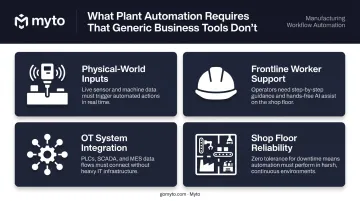
That distinction matters. Generic business process automation wasn't built for the factory floor. Manufacturing plants require tools that:
- Handle physical-world inputs — equipment signals, operator actions, sensor readings, machine error codes
- Support frontline workers who can't sit at desks or type notes between tasks
- Integrate with OT systems including SCADA, MES, CMMS, and ERP — not just cloud applications
- Work reliably in shop floor conditions — noise, PPE, limited connectivity, rotating shifts
Each platform reviewed below was evaluated on how well it handles these in-plant realities.
Best Workflow Automation Platforms for In-Plant Operations
Selection Criteria
Each platform was evaluated on:
- Manufacturing-floor relevance and purpose-built design
- Knowledge capture and documentation capability
- Frontline usability (mobile-first, wearable-ready, low friction)
- Integration depth with MES, ERP, CMMS, and SCADA
- AI or agentic automation features
- Deployment simplicity and infrastructure requirements
Myto
Myto is a manufacturing intelligence platform that solves a problem most workflow tools ignore entirely: the knowledge that never makes it into documents.
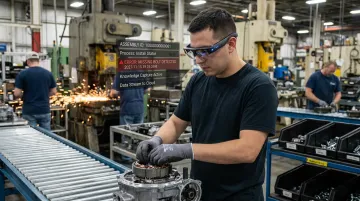
Using AI glasses worn by operators during their normal shifts, Myto captures footage and audio of troubleshooting steps, equipment maneuvers, shift handoffs, and expert behaviors, hands-free, with zero disruption to the operator's workflow.
That captured knowledge flows automatically into the Myto platform, where agentic AI structures it into SOPs, troubleshooting flows, and shift-handover documentation.
What makes this different from every other platform on this list: operators do nothing extra. The glasses record as they work. The expertise that usually walks out the door when a senior technician retires gets preserved and made available to every shift, every operator, every new hire.
The agentic AI layer goes further. Myto's agents are trained on plant-specific data — SOPs, machine history, ticket logs, and captured operator knowledge — and can autonomously:
- Open tickets when equipment issues arise
- Draft structured shift-handover reports
- Schedule maintenance follow-ups
- Surface relevant context when operators ask questions
The platform integrates with existing MES, CMMS, SCADA, and ERP systems — including platforms like Maximo, Fiix, UpKeep, and others — without replacing them. It compounds in intelligence over time as more floor activity, machine history, and captured expertise flow through the system.
Myto is backed by Y Combinator and General Catalyst, with a founding team from Mercedes-Benz, BCG, and Stanford. It's trusted by manufacturers including Mercedes-Benz and Audi.
| Key Capability | Wearable knowledge capture + agentic AI automation for in-plant workflows |
| Best For | Manufacturing facilities looking to eliminate tribal knowledge loss and automate frontline processes |
| Deployment | SaaS subscription; AI glasses bundled; minimal IT lift, no heavy infrastructure required |
Tulip
Tulip is a no-code manufacturing operations platform that lets plant engineers and operations teams build frontline apps, digital work instructions, and automated workflows directly — no software development required.
Its drag-and-drop app builder allows teams to digitize paper-based processes and create step-by-step guided workflows for operators. Tulip connects to machines via Edge IO devices and integrates with existing MES and ERP systems through OPC UA, MQTT, SQL, and HTTP API connectors, making it practical for plants that need to digitize paper-based floor processes without replacing core infrastructure.
On Gartner Peer Insights, Tulip holds a 4.6/5 rating across 121 reviews, and real-world outcomes back the platform's value — TICO Tractors reported that a Tulip quality app cut inspection and rework time by 50–60%. Global manufacturers including Merck and Jabil use the platform.
| Key Capability | No-code app builder for digitizing paper-based workflows and work instructions |
| Best For | Plants digitizing manual processes and building operator-guided production apps |
| Deployment | Cloud-based with on-premise edge device connectivity for machine data |
Augmentir
Augmentir is an AI-native connected worker platform for industrial operations. It provides digital work instructions, remote assist, training tools, and workflow automation for frontline workers — with a "True AI" engine that learns from real worker performance patterns.
That engine is what sets Augmentir apart. Rather than delivering static instructions to all operators equally, it analyzes performance data to identify skills gaps and adapt guidance to individual proficiency levels.
This makes it particularly valuable for plants managing high frontline workforce variability or significant turnover.
Vendor-reported aggregate outcomes include a 37% productivity improvement, 76% reduction in training time, and 27% reduction in downtime. A battery manufacturer case study showed 17% productivity improvement and 40% reduction in onboarding time. The platform supports mobile and wearable devices, including RealWear and Zebra Technologies hardware. LNS Research named Augmentir a Front Runner in its 2023 Connected Frontline Workforce Applications Solution Selection Matrix.
| Key Capability | AI-driven adaptive workflows and connected worker training for industrial frontlines |
| Best For | Manufacturers with high frontline workforce variability or significant training and upskilling needs |
| Deployment | Cloud-based SaaS with mobile and wearable device support |
Poka
Poka is a connected worker platform built specifically for manufacturing, with a focus on knowledge management, skills tracking, and operational communication. It enables plants to capture, organize, and share SOPs, troubleshooting guides, and training content through an interface designed for factory floor conditions.
Poka's differentiator is how it treats operational knowledge — not as static PDFs filed in SharePoint, but as dynamic, searchable, and continuously updated content workers can pull up on the spot. Integrated communication features connect operators, technicians, and supervisors within the production environment rather than pushing them to separate tools.
Danone used Poka as part of its paperless factory initiative, digitizing processes from the ground up using Poka Forms. One manufacturer developed nearly 250 new digital training and work-instruction assets after adopting the platform. In 2023, IFS acquired Poka, integrating its connected worker capabilities alongside IFS ERP, EAM, and FSM — which broadens its enterprise integration story.
| Key Capability | Knowledge management and operational communication for factory floors |
| Best For | Plants prioritizing SOP digitization, skills development, and cross-shift communication |
| Deployment | Cloud-based with mobile app optimized for shop floor environments |
Microsoft Power Automate
Microsoft Power Automate is a broad enterprise workflow automation platform. In manufacturing contexts, it's primarily used to automate administrative and cross-departmental processes — maintenance request routing, quality incident escalations, production reporting, and approval workflows — particularly in organizations already running Microsoft 365, Teams, or Dynamics 365.
Its strength is connecting plant office systems. For example, Custom Air Products used Power Platform to track manufacturing sign-offs, and Microsoft has published a Power Automate RPA template that automates quality order creation in Dynamics 365 Supply Chain Management. Power Automate handles the workflows that surround plant operations rather than production floor automation itself.
Worth noting: premium connectors require a Power Automate Premium user license, and licensing complexity can add up for large deployments. It is not designed for real-time shop floor execution or the physical-world data challenges that purpose-built manufacturing platforms address.
| Key Capability | Enterprise workflow automation for cross-system plant office and administrative processes |
| Best For | Microsoft-centric manufacturing organizations automating back-office and cross-departmental workflows |
| Deployment | Cloud-based (Microsoft 365 / Azure ecosystem); desktop RPA available for legacy systems |
How We Chose These Platforms
In-plant operations have fundamentally different requirements than office or SaaS workflow automation. A common evaluation mistake: comparing platforms on connector count or interface polish rather than manufacturing-floor relevance.
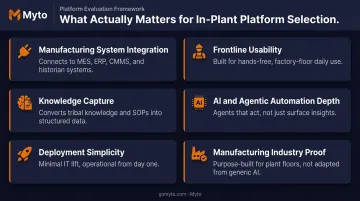
The criteria that actually matter for in-plant decisions:
- Manufacturing system integration — Does it connect to MES, ERP, CMMS, and SCADA, or only to cloud SaaS tools?
- Frontline usability — Is it designed for operators who work with their hands, not desk workers?
- Knowledge capture capability — Can it preserve unstructured operational data like verbal troubleshooting, visual inspection results, and machine error codes?
- AI and agentic automation depth — Does the AI learn from real floor activity, or is it a static rule engine?
- Deployment simplicity — What's the real IT lift to go live on a production floor?
- Manufacturing industry proof — Are there documented use cases in industrial environments, not just generic enterprise deployments?
These criteria connect directly to measurable outcomes. LNS Research reports that 72% of industrial organizations face frontline workforce challenges, and the Manufacturing Institute projects manufacturers may need 3.8 million additional employees by 2033 — with roughly 1.9 million roles potentially going unfilled.
Platforms that score well on the above dimensions reduce unplanned downtime, accelerate operator onboarding, and preserve institutional knowledge before skilled workers retire. That urgency is real: over 25% of the current manufacturing workforce is age 55 or older, according to Bureau of Labor Statistics data.
Conclusion
The right workflow automation platform for in-plant operations is the one that works where your people actually are — on the floor, in the middle of a shift, dealing with a machine that's behaving differently than the manual says. It has to integrate with the systems your plant already runs and pull the knowledge out of your best operators before it disappears.
Start by identifying your biggest operational pain point:
- Shift handoff failures → look at platforms with structured handoff automation (Myto, Poka)
- Tribal knowledge loss → prioritize knowledge capture and documentation capability (Myto)
- Frontline training and workforce variability → consider adaptive guidance platforms (Augmentir)
- Digitizing paper-based floor processes → no-code app builders make sense (Tulip)
- Administrative workflows in a Microsoft environment → Power Automate fits well
For manufacturing facilities where the core problem is undocumented expertise — the knowledge that lives in senior operators' heads and disappears when they retire or call out sick — Myto addresses something the other platforms on this list don't: the physical, hands-on expertise that never makes it into a document. AI glasses capture what operators actually do. Agentic AI turns that into structured workflows. The system compounds — every shift adds to what it knows. If that's the gap you're trying to close, gomyto.com is a good starting point.
Frequently Asked Questions
What are the best workflow automation platforms for in-plant operations?
The top platforms are Myto, Tulip, Augmentir, Poka, and Microsoft Power Automate. The right choice depends on your primary need — whether that's capturing tribal expertise, guiding frontline workflows, digitizing SOPs, training connected workers, or automating enterprise-level administrative processes.
What are the different types of workflow automation used in in-plant operations?
The main categories include knowledge capture and documentation automation, digital work instruction workflows, shift handoff and communication automation, maintenance and quality escalation workflows, and AI-driven agentic workflows that self-trigger based on real-time floor conditions.
How does workflow automation reduce downtime in manufacturing?
Workflow automation standardizes troubleshooting steps, surfaces the right knowledge when an issue occurs, and automates escalation and handoff processes. The result is less time spent searching for answers or waiting on expert guidance — which directly compresses mean-time-to-resolution on the floor.
What should manufacturers look for when choosing a workflow automation platform?
Key criteria: frontline usability designed for operators, integration with existing plant systems (MES, ERP, CMMS), knowledge capture capability, AI capability for floor-level use cases (troubleshooting, documentation, escalation), deployment speed, and verified manufacturing industry use cases.
How is AI-powered workflow automation different from traditional manufacturing automation?
Traditional manufacturing automation (PLCs, SCADA, robotics) controls physical equipment. AI-powered workflow automation acts on operational knowledge and human processes — routing information, generating documentation, suggesting next steps, and learning from how skilled operators work. Both approaches serve distinct functions and work well together on the floor.
Can workflow automation platforms capture tribal knowledge from experienced operators?
Most platforms rely on operators manually inputting SOPs and documentation, which rarely happens consistently on busy production floors. Myto captures knowledge passively through AI glasses as operators work, removing the documentation burden and preserving expertise before it leaves the facility through retirement or turnover.