What makes 2026 different from prior years isn't just volume. Two distinct form factors — AI/audio glasses and AR display glasses — are maturing simultaneously, while major new entrants like Google, Snap, and Xreal prepare launches before year-end. Consumer and enterprise use cases are also converging faster than anyone expected.
This guide covers the five best AI-powered smart glasses available now, how to choose between them, and what each is actually built for.
Key Takeaways
- AI glasses and AR glasses are two different categories — know which one you need before spending a dollar
- Ray-Ban Meta Gen 2 is the best overall AI glasses for everyday use; Viture Beast leads on AR display quality
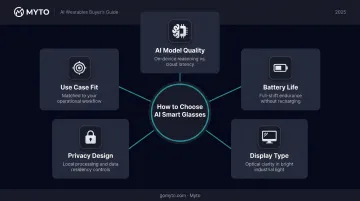
- Four criteria drive the right choice: battery life, AI model quality, display type, and camera vs. camera-free design
- Consumer options run $299–$599; industrial and manufacturing deployments have distinct requirements covered later in this guide
- Always verify prescription lens compatibility and smartphone ecosystem support before buying
What Are AI-Powered Smart Glasses, and Why Do They Matter in 2026?
AI-powered smart glasses are eyewear embedded with microphones, cameras, sensors, and an on-device or cloud AI engine. They can hear, see, understand, and respond — handling navigation, live translation, calls, and contextual queries without you reaching for a phone.
The Two Categories Buyers Need to Know
In 2026, you'll encounter two fundamentally different products that share the same "smart glasses" label:
| Category | Example | Primary Use | Price Tier |
|---|---|---|---|
| AI/audio/camera glasses | Ray-Ban Meta Gen 2 | Hands-free AI assistance, calls, music, content capture | Mid-range |
| AR/display glasses | Viture Beast | Portable productivity, entertainment, spatial computing | Premium |
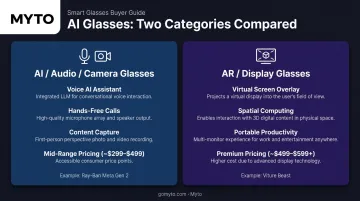
These categories are converging slowly, but they're still distinct purchase decisions with different trade-offs and price points.
The Enterprise Dimension
Beyond consumer use, AI glasses are seeing measurable adoption in manufacturing and field operations. ABI Research forecasts manufacturing AR smart glasses shipments growing at 59% CAGR from 2024 to 2030, making it the second-largest market behind consumer.
The reason is practical: frontline workers can't carry tablets on a production line or stop to type. Hands-free, eyes-up capture of physical workflows solves problems that no app can address.
Myto is one platform built specifically around this use case. It uses purpose-built wearable AI glasses to capture operator knowledge in the natural flow of work, then structures it into SOPs, troubleshooting flows, and shift handover documentation automatically. The deployment model is different from anything on this consumer list, but it illustrates where AI glasses are headed in industrial environments.
The Best AI-Powered Smart Glasses for 2026
These five models were evaluated across AI capability, display quality, comfort, battery life, privacy design, and real-world use case fit. Each pick targets a distinct user need, so the right answer depends on how and where you plan to wear them. Start with the use case that matches yours.
Ray-Ban Meta Gen 2 — Best Overall AI Smart Glasses
Meta's second-generation collaboration with EssilorLuxottica builds meaningfully on the original's mainstream success. The camera is upgraded, the battery is longer, and Meta AI integration has deepened considerably — while keeping the iconic Wayfarer silhouette that makes these socially acceptable in a way most smart glasses aren't.
What sets it apart:
- 12MP ultra-wide camera capturing 3K Ultra HD video — a genuine leap over Gen 1
- Up to 8 hours of battery life, with the charging case extending that by 48 additional hours
- Meta AI handles live translation, visual queries (asking about landmarks, translating physical text), and contextual conversation
- Open-ear speakers deliver solid audio for calls and music without isolating you from your environment
The one honest trade-off: Meta's privacy policy states that AI interactions may be used to personalize ads depending on region. If that bothers you, look at Even Realities G2 instead.
| Spec | Details |
|---|---|
| Camera | 12MP ultra-wide, 3K Ultra HD video |
| Battery | Up to 8 hours active; 48 hours with case |
| AI | Meta AI: live translation, visual queries, voice assistant |
| Best For | Everyday capture, calls, music, hands-free AI assistance |
| Starting Price | From $379 (frame only; configuration affects final price) |
Viture Beast — Best AR Smart Glasses
Viture's flagship AR glasses are built for anyone who wants a large virtual screen for work or travel without strapping on a headset. Sony's Micro-OLED panels inside are the differentiator : this isn't a compromise display.
What sets it apart:
- Sony 0.68-inch Micro-OLED panels delivering 1200p resolution at 1,250 nits of brightness
- 58-degree field of view, 120Hz refresh rate, and a 174-inch virtual display at 4 meters
- SpaceWalker app ecosystem supports multi-screen spatial computing across Windows, macOS, iOS, and Android
- Design is restrained enough for public use despite packing premium display hardware
The trade-off is inherent to the category: Micro-OLED panels are power-hungry, so active use battery life is shorter than AI-only glasses. These are a portable screen, not an all-day wearable.
| Spec | Details |
|---|---|
| Display | Sony Micro-OLED, 1200p, 1,250 nits, 58° FOV, 120Hz |
| Virtual Screen | 174 inches at 4 meters |
| Ecosystem | SpaceWalker (Windows, macOS, iOS, Android) |
| Best For | Travelers, remote workers, portable cinema, productivity screen |
| Starting Price | From $549 |

Oakley Meta Vanguard — Best for Sports and Active Use
The Oakley Meta Vanguard transplants Meta's AI platform into a wraparound sport frame purpose-built for athletes. Announced in September 2025 and available since October 21, 2025, this is what happens when you stop trying to make one pair of glasses do everything and commit to a specific use case.
What sets it apart:
- 12MP ultra-wide camera with a 122-degree field of view, centrally mounted for motion stability
- Up to 9 hours of typical use; charging case adds 36 more hours
- IP67 water and dust resistance — built for outdoor conditions
- Garmin and Strava integration for real-time athletic performance data
- Prizm lenses tuned for specific sport environments
The wraparound sport frame limits how versatile these are outside athletic contexts. For training rides, trail runs, or outdoor workouts, nothing on this list competes.
| Spec | Details |
|---|---|
| Camera | 12MP ultra-wide, 122° FOV |
| Battery | Up to 9 hours active; 36 hours with case |
| Durability | IP67 water and dust resistance |
| Integrations | Garmin, Strava |
| Best For | Cyclists, runners, hikers, athletes |
| Starting Price | $499 |
Even Realities G2 — Best for Privacy-First AI Display
The Even Realities G2 makes a deliberate design choice most smart glasses won't: no camera. That single decision opens doors in offices, conference rooms, courtrooms, and anywhere recording is sensitive or prohibited.
What sets it apart:
- Micro-LED waveguide HUD on each lens: 640 × 350 resolution, 1,200 nits brightness, 27.5° FOV, 60Hz
- 36 grams of magnesium/titanium construction — lightweight for a display device
- Two-day battery life under normal use patterns
- Even HAO 2.0 optics deliver AR overlay for navigation, teleprompter, real-time translation, and AI prompts
- Prescription lenses available from $159; single-vision options supported directly
- Optional Even R1 smart ring ($249) for discrete interaction controls
The display FOV (27.5°) is narrower than AR-first glasses like the Viture Beast. That's an intentional trade-off for discretion and battery efficiency.
| Spec | Details |
|---|---|
| Display | Micro-LED waveguide, 640×350, 1,200 nits, 27.5° FOV |
| Weight | 36 grams |
| Battery | Two-day (typical use) |
| Camera | None by design |
| Best For | Professionals, speakers, privacy-conscious users |
| Starting Price | From $599 |
Solos AirGo V — Best Battery Life
Solos positions the AirGo V as a Ray-Ban Meta alternative for users who want longer AI access and prefer ChatGPT over Meta AI. The modular design (swappable arms across frame styles) is a practical differentiator for buyers who want flexibility.
What sets it apart:
- 10+ hours for music streaming under active use; up to 16 hours for photo shooting and AI queries
- ChatGPT/OpenAI integration for visual AI queries via still photos
- Modular arms allow switching between camera, everyday, and sport configurations
- Max image resolution: 2048 × 1944; notification LED signals active camera use
The trade-offs are real. The AirGo V captures still images only, no video, and image quality sits below Ray-Ban Meta standards.
The modular arms, while useful, add bulk compared to slimmer competitors. If battery life and ChatGPT access are your priorities, it's the right call. If you want video and a more polished form factor, it isn't.
| Spec | Details |
|---|---|
| Battery | 10+ hours music; ~16 hours AI/photo use |
| AI | ChatGPT/OpenAI integration |
| Camera | Still photos only (2048×1944); no video |
| Design | Modular swappable arms |
| Best For | Power users who prioritize all-day AI access |
| Starting Price | $299 |
How We Chose the Best AI-Powered Smart Glasses
The biggest mistake buyers make is selecting based on the most impressive spec sheet rather than their actual daily context. A 174-inch virtual display means nothing if you mainly want hands-free calls on a commute. A 9-hour sport battery is irrelevant if you sit at a desk.
Criteria used in this evaluation:
- Real-world AI capability — whether the AI performs reliably for the tasks the product claims, not just whether the label appears
- Comfort and wearability tested over extended periods, not just initial impressions
- Active-use battery life — how long the glasses last during actual use, not standby figures
- Camera or display quality measured against price tier, compared within category
- Privacy design transparency — what data is collected, processed, and used for targeting
Factors that drove final differentiation:
- AI model quality and depth of integration — on-device processing vs. a Bluetooth shortcut to your phone
- Display type and brightness for AR models
- Prescription lens compatibility, given roughly half of adults need vision correction
- Companion app stability and ecosystem maturity
- Whether the device is purpose-built for its claimed use case or a generic product with a marketing claim attached
Conclusion
The first decision is categorical, not brand-based: AI glasses or AR glasses. Get that wrong and no amount of research on individual models will help.
Once you've answered that, match the product to the use case:
- Everyday AI assistance → Ray-Ban Meta Gen 2
- Portable AR screen → Viture Beast
- Athletic performance → Oakley Meta Vanguard
- Privacy-first professional use → Even Realities G2
- Maximum battery + ChatGPT → Solos AirGo V
The market is moving fast. Google's Android XR glasses with Gemini integration, Snap's consumer Specs launch, and Xreal's Project Aura (featuring up to 70-degree FOV) are all expected before year-end. If you're not in a hurry, waiting six months could yield substantially better options. If you need capable hardware now, the five above are the most proven choices currently available.
For manufacturing and industrial operations teams: consumer AI glasses aren't designed for the factory floor, and deploying them there and the gaps show quickly. Myto's platform is built specifically for that environment — wearable AI glasses provisioned as part of a SaaS subscription, paired with agentic AI that captures operator expertise, auto-generates SOPs, and coordinates shift handovers. No extra steps required from workers. If your operation is losing production hours to unplanned downtime or retiring operators taking institutional knowledge with them, it's worth a conversation. You can book a 30-minute discovery call at gomyto.com.
Frequently Asked Questions
What are AI-powered smart glasses?
AI-powered smart glasses are eyewear embedded with microphones, cameras, and an AI engine that can answer questions, translate languages, capture content, and deliver hands-free digital assistance. You don't need to pull out a phone: the AI responds to voice or visual context directly through the glasses.
Do AI-powered smart glasses really work?
For specific tasks — hands-free calls, music, live translation, and content capture — yes, they work well. Full AR overlay experiences are still maturing on most consumer models. Best approach: match the glasses to one or two core tasks you actually need, rather than expecting them to replace your phone entirely.
What is the difference between AI glasses and AR glasses?
AI glasses focus on intelligent assistance (voice AI, translation, calls, contextual answers) with no display. AR glasses project a virtual screen onto the lenses. Some 2026 models combine both, but they remain largely separate categories with different price points and trade-offs.
How long does the battery last on AI smart glasses?
Battery life varies significantly by model and workload. The Ray-Ban Meta Gen 2 delivers around 8 hours under typical active use; the Solos AirGo V exceeds 10 hours for audio and up to 16 hours for AI and photo tasks. AR display glasses with Micro-OLED panels drain faster. Always compare active-use figures, not standby.
Can I get AI-powered smart glasses with prescription lenses?
Several leading models support prescriptions — Ray-Ban Meta Gen 2 and Even Realities G2 both offer prescription options, with Even Realities listing single-vision prescriptions from $159. Verify the compatible range and lens type with the manufacturer, since not all frame configurations support every prescription.
Are AI smart glasses safe for privacy?
Privacy risks vary by model. Camera-equipped glasses raise real concerns around bystander recording and data use — Meta, for example, may use interaction data to personalize ads. Camera-free models like the Even Realities G2 eliminate this risk by design. Check the data policy and camera indicator options before buying.