Predictive maintenance software has emerged as the primary answer. Rather than waiting for equipment to fail or servicing it on a fixed calendar, these platforms use real-time sensor data and AI to detect failures before they happen.
This article covers the five strongest predictive maintenance platforms for manufacturing and industrial operations — and what separates the tools that actually reduce downtime from the ones that just generate alerts.
Key Takeaways
- Predictive maintenance software shifts teams from reactive repairs to data-driven early intervention using IoT sensors and AI/ML models.
- The best platforms connect detection directly to work order execution — alerts that don't become completed repairs don't reduce downtime.
- Top tools for 2024–2025: MaintainX, IBM Maximo, Tractian, AssetWatch, and Augury — each suited to different scales and needs.
- Selection criteria that matter: sensor integration depth, AI diagnostic quality, ease of frontline adoption, and scalability.
- Even the best predictive maintenance software falls short if technicians lack the operational context to act fast when alerts fire.
What Is Predictive Maintenance Software?
Predictive maintenance software is a platform that connects real-time asset condition data (IoT sensors, PLCs, and SCADA systems) to maintenance workflows, detecting failure patterns before they cause unplanned stoppages.
That's distinct from two older approaches:
- Preventive maintenance — fixed-schedule servicing regardless of actual equipment condition. Efficient on paper, but it often services equipment that doesn't need it yet while missing developing failures.
- Reactive maintenance — fix it when it breaks. Low upfront cost, high disruption cost.
Predictive maintenance threads between them: act only when real data signals a problem, before it becomes a failure.
How the Technology Works
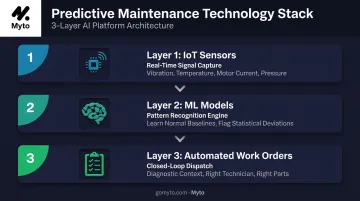
The core stack has three layers:
- IoT sensors measuring vibration, temperature, motor current, and pressure stream continuous data from monitored assets
- ML models learn what "normal" looks like for each machine and flag statistical deviations as early warning signals
- Automated work orders are generated with diagnostic context attached, routing the right technician with the right parts and information
Deloitte's predictive maintenance research indicates the approach can reduce breakdowns by 70% and lower maintenance costs by 25%. Siemens puts the potential reduction in unplanned machine downtime at 50%.
The value depends entirely on how well detection connects to execution. The platforms below were evaluated on that specific dimension — how reliably each converts early signals into resolved work orders for manufacturing and industrial teams.
Best Predictive Maintenance Software for Reducing Unplanned Downtime
These platforms were evaluated on sensor integration depth, AI/ML diagnostic capability, work order automation, ease of deployment, and real-world manufacturing applicability.
MaintainX
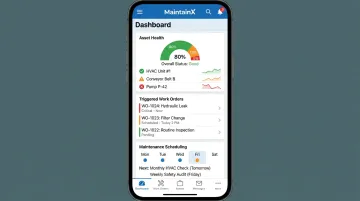
MaintainX is an AI-powered, mobile-first CMMS that has expanded into predictive maintenance through plug-and-play integrations with industrial IoT platforms — including MachineMetrics, AssetWatch, Kepware, and MQTT. It's widely adopted across general manufacturing, food & beverage, and distribution. Rated 4.8 stars from 427 ratings on Gartner Peer Insights, with strengths in intuitive mobile workflows and real-time dashboards.
Where it stands out:
- Automatic work order generation triggered by sensor anomaly events
- Usage- and condition-based maintenance scheduling alongside calendar PM
- Asset health dashboards with AI-powered reporting
- Mobile-first interface built for frontline adoption with minimal training friction
| Category | Details |
|---|---|
| Key Features | Sensor/IoT integration via third-party connectors, automated work order generation, asset management, PM scheduling, inventory tracking, real-time reporting |
| Best For | Mid-market to enterprise manufacturing and facilities teams needing a full CMMS with predictive add-ons and strong mobile adoption |
| Deployment / Pricing | Cloud-based SaaS; check current pricing tiers at the MaintainX website — plans vary by team size and feature set |
IBM Maximo
IBM Maximo is an enterprise asset management platform backed by IBM's AI and IoT capabilities (Watson), with decades of deployment history across heavy industry, utilities, oil & gas, and large-scale manufacturing.
Key capabilities:
- AI and ML models that analyze historical maintenance data alongside real-time IoT sensor readings to predict failures
- Centralized asset records, workflows, inventory, and lifecycle management in one system
- Custom dashboards for asset health visualization across multi-site operations
- Deep ERP integration for organizations running SAP or Oracle
The tradeoff: Gartner and G2 reviewers consistently flag implementation complexity, the requirement for specialized skills (OpenShift/Kubernetes), and a steep learning curve. Maximo delivers breadth, but realizing that breadth requires dedicated IT resources.
| Category | Details |
|---|---|
| Key Features | AI/ML-driven failure prediction, condition-based monitoring, IoT data ingestion, asset lifecycle management, custom reporting, ERP integration |
| Best For | Large enterprises in heavy industry, utilities, or multi-site manufacturing with significant IT support |
| Deployment / Pricing | On-premise or cloud (IBM Cloud/SaaS); verify current licensing directly with IBM — pricing varies significantly by configuration |
Tractian
Tractian is a manufacturing-focused platform that natively combines wireless vibration and temperature sensors (Smart Trac Ultra) with an AI-powered CMMS in a single native system. The design eliminates the manual handoffs between separate monitoring and management tools.
What sets it apart:
- AI diagnostics that identify specific failure modes — not just anomalies — with root cause information, severity level, and recommended repair steps attached directly to the work order
- Native sensor-to-work order pipeline with no middleware required
- Mobile execution with offline capability for plant floor environments
- Real-time dashboards tracking MTTR, backlog, and PM compliance
Tractian cites 43% reduction in unplanned downtime and 25% faster maintenance response in published aggregate outcomes. Deployment timelines run 30–60 days for initial asset coverage.
| Category | Details |
|---|---|
| Key Features | Native sensor-to-CMMS integration, AI failure diagnostics, automated prescriptive work orders, mobile offline access, real-time KPI dashboards, parts/inventory linking |
| Best For | Manufacturing teams (automotive, food & beverage, chemicals, mining) wanting a single integrated system from sensor to completed repair |
| Deployment / Pricing | Cloud-based SaaS; check Tractian's website for current condition monitoring and CMMS pricing tiers |
AssetWatch
AssetWatch pairs wireless vibration and temperature sensors with AI anomaly detection and a team of certified human reliability analysts who validate findings and deliver prescriptive recommendations. It bridges the gap between automated alerts and expert-verified action.
Core strengths:
- Continuous condition monitoring with wireless sensors streaming data in real time
- A dedicated condition monitoring engineer assigned to each account for human-validated insights
- Integrated lubrication and oil analysis alongside vibration monitoring
- Automatic work order creation in connected CMMS platforms when threshold alerts trigger
- Local field reliability technicians available for on-site support
Published case studies include a cement manufacturer achieving 57x ROI within six months and Worthington Steel reporting $500,000 in potential lost gross margin saved — vendor-published figures, not independently verified.
| Category | Details |
|---|---|
| Key Features | Wireless vibration/temperature sensors, AI + human analyst validation, lubrication/oil analysis, CMMS work order integration, dynamic ROI dashboards |
| Best For | Mid-market manufacturers without large in-house reliability teams who want hands-on expert support alongside automation |
| Deployment / Pricing | Hardware + SaaS model; contact AssetWatch directly for pricing based on asset count and monitoring scope |
Augury
Augury is an AI-driven machine health platform focused on deep condition monitoring. It uses proprietary sensors and machine learning trained on an extensive library of industrial machine data to deliver component-level fault diagnosis and prescriptive maintenance recommendations.
What makes it distinctive:
- Highly specialized AI models capable of identifying specific component failures — bearings, belts, gears — with high diagnostic precision
- Automatic CMMS/EAM work order sync for execution without manual handoffs
- Machine health scoring across asset groups, not just individual alerts
- Strong focus on extending asset lifespan, not just preventing individual failures
A commissioned Forrester Total Economic Impact study (July 2025) reported 310% ROI over three years and payback in under six months for a composite $20B organization, with $16.8M saved from reduced unplanned downtime.
| Category | Details |
|---|---|
| Key Features | Component-level AI fault diagnosis, continuous condition monitoring, CMMS/EAM work order sync, machine health scoring, prescriptive maintenance recommendations |
| Best For | Production-critical manufacturing environments where diagnostic accuracy and machine health depth outweigh cost considerations |
| Deployment / Pricing | Enterprise SaaS with hardware component; contact Augury for current pricing — typically deployed at scale across production-critical asset groups |
How to Choose the Right Predictive Maintenance Software
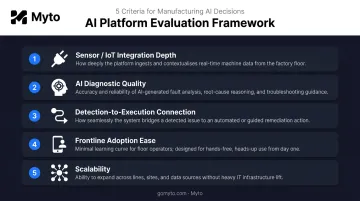
Five Evaluation Criteria That Matter
These tools were assessed on:
- Sensor/IoT integration depth — Does the platform support your existing sensors, PLCs, and SCADA systems natively, or does it require significant middleware?
- AI diagnostic quality — Is the system flagging anomalies, or identifying specific failure modes with root cause context? The gap between "something's wrong" and "bearing fault in Motor 3, severity high, replace within 72 hours" is what drives response speed.
- Detection-to-execution connection — How many manual steps exist between an alert and a completed work order? Every handoff is a delay.
- Frontline adoption ease — Mobile-first interface, offline capability, minimal training overhead. If techs won't use it, alerts pile up unactioned.
- Scalability — Can the platform expand from a pilot on five assets to plant-wide or multi-site coverage without a full reimplementation?
The Integration Question Most Buyers Skip
A platform with superior AI but poor integration creates data silos that slow response. A solid CMMS with shallow sensor integration leaves detection gaps.
Map your current tech stack — ERP, CMMS, SCADA, PLCs — before evaluating vendors. The right question is which platform integrates cleanly with what you already run, not which one has the most impressive AI demo.
McKinsey research identifies low-quality data, inadequate IT infrastructure, and weak change management as the primary reasons predictive maintenance programs fail to scale — not the AI models themselves.
The Missing Layer: When Alerts Need Context to Become Action
Even the best predictive maintenance platforms leave one gap unaddressed.
When a sensor triggers an alert and a work order auto-generates, the technician responding needs more than a task. They need the machine's repair history, the workaround that actually holds on that specific line, and the step the veteran tech always takes before running the diagnostic sequence. None of that lives in the CMMS.
This is the tribal knowledge problem. According to the Manufacturing Institute and Deloitte, 2.8 million manufacturing positions are expected to open due to retirements over the next decade — and with them goes decades of undocumented machine expertise. Siemens' 2024 data reflects the early impact: average recovery time after downtime has risen from 49 minutes five years ago to 81 minutes today, partly driven by skills and knowledge gaps.
Where Myto Fits
This is the gap Myto's platform is built to close. Myto operates as an intelligence layer alongside existing CMMS and EAM systems, ingesting work order history, machine logs, maintenance tickets, and SCADA/ERP data.
It combines that operational data with hands-free captured knowledge from AI glasses worn by experienced technicians during repairs and troubleshooting sessions.
The glasses record what actually happens on the floor — the expert behavior that never makes it into any manual. That captured expertise is structured into:
- Reusable troubleshooting flows tied to specific machines and failure types
- Step-by-step SOPs generated from real repair sessions
- Diagnostic checklists searchable by the next technician facing the same problem
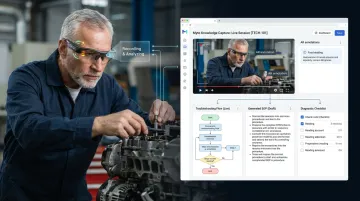
When a predictive maintenance alert fires, technicians aren't starting from zero. The AI surfaces equipment history, relevant SOPs, likely root causes, and visual diagnostic aids for that specific machine and failure type.
Predictive maintenance software tells you what's about to fail. Myto ensures the team actually knows how to fix it fast. Without that institutional knowledge layer, detection alone still produces slow, inconsistent repairs — a gap that only widens as experienced operators retire.
Conclusion
The right predictive maintenance software isn't determined by sensor specs or AI feature lists. MaintainX, IBM Maximo, Tractian, AssetWatch, and Augury are all solid platforms. Which one fits depends on your integration readiness, team size, in-house reliability expertise, and how much diagnostic depth you actually need.
Start by auditing your current downtime patterns: where failures are occurring, how long recovery takes, and where the bottlenecks in your maintenance workflow actually live. That audit will tell you more about which platform fits than any feature comparison.
And if your team is also losing time because critical machine knowledge exists only in your most experienced operators' heads, that's a separate gap that predictive maintenance software alone won't close. Explore how Myto's platform can turn that undocumented expertise into structured operational knowledge your maintenance teams can act on, every shift — even after your best people retire.
Frequently Asked Questions
What is predictive maintenance software and how does it work?
Predictive maintenance software uses IoT sensors to collect real-time equipment data — vibration, temperature, motor current — then applies AI/ML models to detect abnormal patterns before failure occurs. When the system flags a developing issue, it automatically generates a work order with diagnostic context, shifting teams from reactive repair to proactive intervention.
How is predictive maintenance different from preventive maintenance?
Preventive maintenance runs on a fixed schedule regardless of actual equipment condition. Predictive maintenance triggers action only when real-time sensor data signals a developing problem — avoiding both under-maintenance of at-risk assets and unnecessary servicing of healthy ones.
What features should I look for in predictive maintenance software?
Five capabilities matter most:
- Native sensor/IoT integration across asset types
- AI-powered failure-mode diagnostics (not just anomaly alerts)
- Automated work order generation with diagnostic context attached
- Mobile execution capability for floor technicians
- Real-time KPI dashboards tracking MTTR and MTBF
How long does it take to see ROI from predictive maintenance software?
Most teams cite 12–18 months as a typical payback period. Large manufacturers that catch major failures early can recover investment in as little as three months, with enterprise-scale deployments sometimes reaching payback in under six months.
Can predictive maintenance software be used on older equipment?
Most modern platforms support wireless retrofit sensors that attach to legacy equipment without complex wiring or infrastructure upgrades, making predictive monitoring accessible even in facilities without major recent upgrades.
How does predictive maintenance software integrate with existing CMMS or ERP systems?
Most platforms integrate via APIs or native connectors with common CMMS and ERP systems. Sensor-triggered alerts automatically create work orders, update asset records, and feed performance data back into existing management workflows — eliminating duplicate data entry across systems.